Why Does Takuya Yagami Hate Ayanokoji?
Takuya Yagami hates Ayanokoji because White Room comparisons turned admiration into envy, making him desperate to defeat the program's "masterpiece."

Why Takuya Yagami Hates Ayanokoji
Yagami's hatred comes from a mixture of indoctrination, wounded pride, envy, and an obsessive need for recognition.
He and Ayanokoji were both raised within the White Room, the secret educational institution connected to Ayanokoji's father. The program attempts to manufacture exceptional human beings through extreme academic, physical, and psychological training. However, Yagami and Ayanokoji did not belong to the same generation.
Ayanokoji was the greatest success of the brutal fourth generation. Yagami came from the fifth generation, which used a different and comparatively less destructive curriculum. By the time Yagami was old enough to understand his own abilities, Ayanokoji's reputation already dominated the institution.
To the White Room, Ayanokoji was not merely another successful student. He was the benchmark against which later students were measured.
That created a humiliating contradiction for Yagami. He had excellent abilities and stood near the top of his own generation, yet the institution still treated him as inferior to someone he had never properly faced. His accomplishments did not allow him to escape Ayanokoji's shadow.
Yagami consequently internalized a simple idea: if he could defeat Ayanokoji, he could invalidate the hierarchy imposed on him.
His hatred is therefore personal in emotion but institutional in origin.
Yagami's White Room Background
Yagami is introduced publicly as a polite and intelligent first-year student in Class 1-B. The official Season 4 character profile describes him as the class leader, a high-performing student with good judgment who behaves respectfully toward older students. It also presents him as someone supposedly connected to Horikita and Kushida through their middle-school background.
That harmless identity is a cover.
The light novel eventually reveals that Yagami is one of the White Room students sent into the Advanced Nurturing High School environment during Ayanokoji's second year. His mission is tied to the wider attempt to force Ayanokoji out of school and return him to his father's control.
Yagami is not the only first-year student connected to the White Room plot. Ichika Amasawa also comes from the institution, although her attitude toward Ayanokoji differs sharply from Yagami's. Amasawa recognizes Ayanokoji's extraordinary ability and develops a form of admiration for him. Yagami interprets the same reputation as an insult to his own worth.
That contrast is central to understanding him.
Both students grew up hearing about the same person. One became fascinated by him. The other became consumed by the need to surpass him.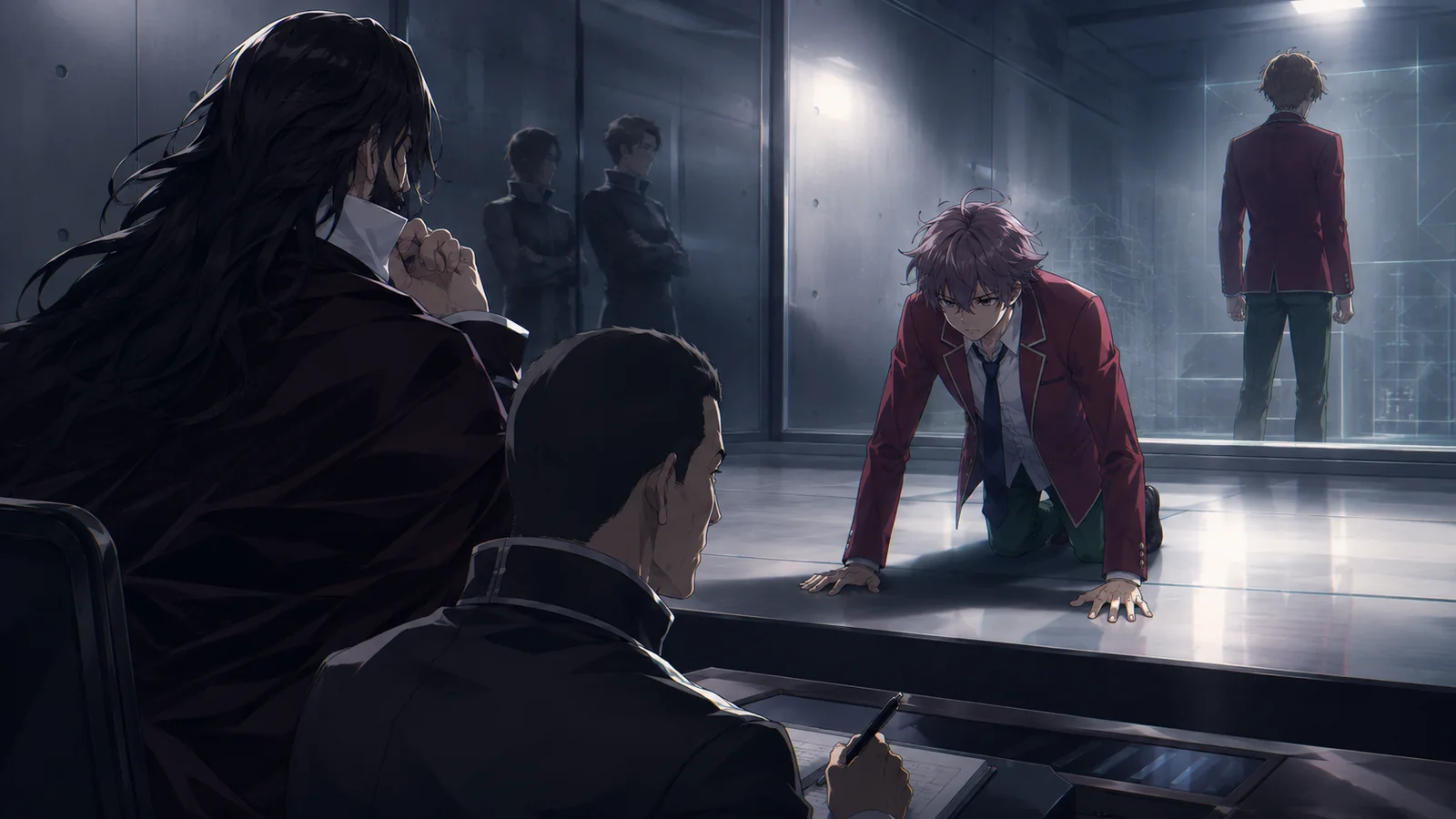
Ayanokoji Represents Everything Yagami Cannot Accept
Yagami does not hate Ayanokoji because Ayanokoji bullied, betrayed, or directly harmed him before they entered the school. Their conflict begins without a conventional personal grievance.
Instead, Ayanokoji represents several things Yagami cannot tolerate.
Ayanokoji Is the White Room's Unreachable Standard
The White Room trains children to think in terms of performance, rankings, utility, and results. Personal identity becomes inseparable from measurable ability.
Within that environment, being told that someone else is fundamentally superior is not a minor criticism. It attacks the foundation on which a student's self-worth has been constructed.
Yagami believes he possesses outstanding intelligence, physical ability, manipulation skills, and adaptability. Yet his instructors' evaluation of Ayanokoji implies that those qualities are still not enough.
Ayanokoji's existence makes Yagami feel pre-defeated.
He has not lost an actual contest, but the institution has already delivered its judgment. Yagami's obsession is his attempt to overturn that judgment through direct action.
Ayanokoji Escaped the System
Ayanokoji also achieved something Yagami did not: he left the White Room and began building a life outside it.
That freedom complicates Yagami's resentment. The person celebrated as the institution's masterpiece is no longer even participating in its system. Ayanokoji does not appear interested in defending his title or proving that he deserves it.
For Yagami, this indifference is infuriating.
Yagami desperately wants the confrontation to validate his existence, while Ayanokoji initially has little interest in treating him as a rival. The emotional imbalance makes Yagami more aggressive. He needs Ayanokoji to acknowledge the contest because victory means less if the supposed champion refuses to play.
Ayanokoji Receives the Recognition Yagami Wants
Yagami's behavior suggests that he does not merely want to complete an assignment. He wants recognition as the superior White Room student.
This distinction matters because a disciplined operative would prioritize the simplest available method of removing Ayanokoji. Yagami repeatedly chooses complicated schemes, indirect pressure, hidden messages, manipulated students, and escalating provocations.
Those choices reveal ego.
He does not want Ayanokoji eliminated by circumstance or by somebody else's plan. He wants to demonstrate that he personally outsmarted him.
Is Yagami's Hatred Really Jealousy?
Jealousy is the clearest description, although it does not explain every part of his motive.
Yagami envies Ayanokoji's status, abilities, reputation, and freedom. He resents being treated as a lesser product despite excelling within his own generation. He also appears angry that Amasawa respects Ayanokoji more than she respects him.
However, the conflict goes beyond ordinary jealousy.
Yagami's entire understanding of human value was shaped by the White Room. He was trained to see superiority as something objective and provable. If Ayanokoji is superior, then Yagami's identity as an elite student becomes unstable.
Defeating Ayanokoji is thus not simply about winning a rivalry. In Yagami's mind, it would prove that the White Room was wrong about him.
That is why his emotional response becomes so extreme. He is trying to repair his self-image through domination.
How Yagami Acts on His Hatred
Yagami hides his hostility behind a friendly and composed public persona. Rather than confronting Ayanokoji immediately, he manipulates events from the background.
His methods include exploiting Kushida, influencing other first-year students, planting information, redirecting suspicion, and creating situations that could damage Ayanokoji or those around him.
He Uses Kushida as a Tool
Yagami's fabricated middle-school connection helps him approach Kushida. Because Kushida has her own reasons for wanting Ayanokoji and Horikita removed, she becomes useful to him.
Yagami encourages her hostility while concealing the full truth about himself. He understands that Kushida can create instability inside Ayanokoji's class without exposing Yagami as the person directing events.
The relationship is not built on trust. Yagami treats her as a disposable asset.
He Manipulates the First-Year Conflict
During the first part of Ayanokoji's second year, several first-year students appear to be competing to expel him. Hosen acts openly, while Nanase follows a more emotionally complicated path. Tsubaki and Utomiya also become involved in plans surrounding Ayanokoji.
Yagami operates more carefully than these visible threats.
He benefits from an environment in which multiple students have motives to target Ayanokoji because the confusion gives him cover. He can interfere, provoke reactions, and gather information while allowing suspicion to fall elsewhere.
He Escalates During the Uninhabited Island Exam
The island exam gives Yagami an opportunity to influence several moving parts at once. Events involving injured students, hidden communications, Kushida, first-year groups, and an anonymous message to Horikita all contribute to a larger network of suspicion.
The exact responsibility for every individual event is revealed gradually rather than presented in one immediate confession. What becomes clear is that Yagami has been engineering conflict while testing how Ayanokoji responds.
This is where his mission begins turning into a game.
Instead of pursuing only the practical goal of expulsion, Yagami creates clues and challenges. He wants Ayanokoji to notice that an intelligent enemy is operating nearby.
That need to be recognized becomes one of his greatest weaknesses.
Why Yagami Does Not Attack Ayanokoji Directly
Yagami believes a straightforward confrontation would not fully prove his superiority.
A physical fight could demonstrate strength, but Yagami wants a broader victory. He wants to show that he can control the school environment, manipulate other students, conceal his identity, and force Ayanokoji into an unwinnable position.
He also knows that direct violence could expose his background or result in immediate punishment.
More importantly, Yagami enjoys the psychological contest. He wants Ayanokoji to understand who defeated him.
This desire separates Yagami from a purely obedient White Room agent. He is supposed to help remove Ayanokoji, but his pride encourages him to delay, experiment, and pursue a personally satisfying victory.
That delay gives Ayanokoji time to identify him.
How Ayanokoji Figures Out Yagami's Identity
Ayanokoji does not need Yagami to openly confess before recognizing that something is wrong.
Yagami's actions create a pattern. Information reaches the right people too conveniently. Certain first-year movements appear connected. Anonymous messages contain clues that can be traced through habits, knowledge, and timing. The supposed middle-school history involving Kushida also deserves scrutiny.
Ayanokoji combines these irregularities instead of judging each incident separately.
He also understands the psychology of the White Room. An ordinary student might see Yagami as merely intelligent and helpful. Ayanokoji can consider the possibility that Yagami's polished behavior is the result of specialized training.
The key point is that Yagami underestimates how little direct evidence Ayanokoji needs. Yagami thinks concealment will let him control the pace of the contest. Ayanokoji instead observes him, identifies the underlying structure, and waits for the best moment to remove the threat.
Why Yagami Loses Despite His Ability
Yagami is one of the most capable students introduced during the second-year arc. His defeat does not mean he was unintelligent or physically weak.
He loses because his emotional motive corrupts his decision-making.
He Needs Ayanokoji's Attention
A more controlled opponent would avoid leaving unnecessary clues. Yagami repeatedly invites attention because he wants Ayanokoji to notice him.
His schemes are partly tactical and partly performative.
Every extra provocation increases the chance that someone will connect him to the incidents. His obsession makes him less patient than he believes himself to be.
He Mistakes Complexity for Superiority
Yagami constructs layered plans involving several students and conflicting motives. This makes him dangerous, but it also creates more points of failure.
Ayanokoji does not need to defeat every part of the plan individually. He only needs to understand Yagami's goal and create a situation where Yagami exposes himself.
Yagami believes that controlling more variables demonstrates greater intelligence. Ayanokoji wins by simplifying the problem.
He Cannot Control His Inferiority Complex
Yagami's polite personality collapses when his position is threatened.
This loss of composure confirms that his confidence was fragile. He can manipulate others while he believes he is in control, but he reacts badly when Ayanokoji denies him the grand confrontation he imagined.
The White Room taught Yagami to perform at an elite level. It did not free him from the need to prove that he mattered.
What Happens to Yagami in Year 2 Volume 7?
Yagami's conflict reaches its decisive point in Classroom of the Elite: Year 2 Volume 7, published in English by Seven Seas Entertainment.
During the cultural festival period, several separate threads converge around Yagami. Ayanokoji works with other students and uses accumulated evidence, suspicions, and carefully directed messages to bring Yagami into a controlled situation.
Yagami is confronted over incidents connected to the island exam and other manipulations. Once he realizes that he has been cornered, his calm persona breaks down.
He attempts to resist physically, demonstrating that the harmless image he presented at school was false. However, staff connected to the White Room intervene and remove him.
Yagami is expelled without receiving the direct, equal confrontation he wanted.
That outcome is especially devastating for him because it denies his entire objective. He does not prove himself superior. He does not force Ayanokoji to fight seriously in front of him. He is removed after being maneuvered into exposing his own instability.
Ayanokoji defeats him primarily by understanding his psychology.
The bottom line: Yagami hates Ayanokoji because the White Room taught him to measure his worth against an unreachable predecessor. His campaign is an attempt to prove he is not inferior, which lets Ayanokoji defeat him by exploiting the pride behind that obsession.